In fact, many contemporary,

Stumbleupon Review of :

In fact, many contemporary, nonindustrialized cultures contentedly pass portions of the night in the same state of somnolence, says Carol Worthman, an anthropologist at Emory University who is one of the first to look at how other societies sleep. Sleep and wakefulness are rarely seen as an either/or, but rather as two ends of a wide spectrum, and people are far more at peace with the fluidity in between. Among the Efe in Zaire, and the !Kung in Botswana, for example, someone who wakes up in the middle of the night and cannot sleep “may begin to hum, or go out and play the thumb piano,” Worthman and a colleague have written. Others might wake up and join in. “Music or even a dance may get going.”

Worthman says, “In our culture, quality sleep is going into a dark room that is totally quiet, lying down, falling asleep, doing that for eight hours, and then getting up again.” She calls it the “lie down and die” model. “But that is not how much of the world has slept in the past or even sleeps today.” In some cultures sleep is more social, with crowds crammed together on little or no bedding, limbs entangled, while a steady traffic comes and goes. And while it all sounds unbearable, Worthman notes that science has never looked empirically at whether our more sophisticated arrangements actually benefit us. For children, learning to sleep amid all that stimulation may actually have developmental advantages.

Still, we can’t afford the same equanimity about not sleeping through the night as the Efe and !Kung; the flipside is that men and women in those cultures are content to pull a cloth over their faces and doze off during the day if necessary. Our peculiar preference for one well-organized hunk of sleep likely evolved as a corollary to our expectation of uninterrupted wakefulness during the day — as our lives came to be governed by a single, stringent clock. Eluned Summers-Bremner, author of the forthcoming “Insomnia: A Cultural History,” explains that in the 18th century, “we start overvaluing our waking time, and come to see our sleeping time only as a way to support our waking time.” Consequently, we begin trying to streamline sleep, to get it done more economically: “We should lie down and go out right away so we can get up and get to the day right away.” She describes insomniacs as having a ruthless ambition to do just this, wanting to administer sleep as an efficiency expert normalizes the action in a factory. Certainly all of us, after a protracted failure to fall asleep for whatever reason, have turned solemnly to our alarm clocks and performed that desperate arithmetic: If I fall asleep right now, I can still get four hours.

Nevertheless, while it may be at odds with our history and even our biology, lie-down-and-die is the only practical model for our lifestyle. Unless we overhaul society to tolerate all schedules and degrees of sleepiness and attentiveness, we are stuck with that ideal. Perhaps the real problem is that we still haven’t come to terms with the unavoidable imperfection of this state of affairs.

Electric light didn’t obliterate nighttime so much as reinvent it. Our power to toggle between light and dark encouraged us to see night as an empty antithesis to day — an unbroken nothing-time that begins the instant we flip off the switch. And this significantly reshaped and rigidified our expectations of how we ought to be spending it. All of this leaves us — regardless of the circumstances or how poor our sleep hygiene is — insisting that we go out, and stay out, like a light.

Posted in Misc | Tagged | Leave a comment

tracker.nxvr.org

Stumbleupon Review of : http://tracker.nxvr.org/

If you ain’t learnin’ you ain’t livin’:

Information wants to be consumed.

    (preferably by cephalopods)
Posted in Computing | Tagged | 2 Comments

Bunty


Stumbleupon’s come a long way.

Remember when all this used to be fields?

Posted in Computing | Tagged , , | Leave a comment

The Oil Drum: Europe | Concentrating Solar Power

150 MW of parabolic trough CSP plant at Kramer Junction, California.

The statistics are quite startling. Every year, each square kilometre of hot desert receives solar energy equivalent to 1.5 million barrels of oil. Multiplying by the area of deserts worldwide, this is several hundred times the entire current energy consumption of the world. It has been calculated that, if it was covered with CSP plants, an area of hot desert of about 254 km x 254 km–less than 1% of the total area of such deserts – would produce as much electricity as is currently consumed by the whole world.

The cost of collecting solar thermal energy equivalent to one barrel of oil is about US$50 right now (already less than the current world price of oil) and is likely to come down to around US$20 in the future. The MED-CSP report, published in 2005, suggests that CSP will need public support for a time (like other renewable forms of energy) but that, with economies of scale and refinements in the technology, the cost of CSP electricity is then likely to tumble relative to more traditional sources of electricity. The TRANS-CSP report calculates that CSP is likely to become one of the cheapest sources of electricity in Europe, including the cost of transmission.

A report in Business Week (2006-02-14) quotes the CEO of Solel as saying “Our [CSP] technology is already competitive with electricity produced at natural-gas power plants in California”. Similar claims are being made by others in the industry. Speaking about CSP at the Solar Power 2006 conference in California, the US venture capitalist Vinod Khosla said “…we are poised for breakaway growth – for explosive growth – not because we are cleaner [than coal-fired electricity] but because we are cheaper. We happen to be cleaner incidentally.”

Posted in Science | Tagged , | Leave a comment

Wildfire – Wikipedia, the free encyclopedia

Posted in Science | Tagged , | Leave a comment

en.wikipedia.org/wiki/Image:Deerfire_high_res.jpg

Posted in Arts, Photography | Leave a comment

bukowski.net/vault/poem1984-07-19-this_is_free_take_it_and_feel_better.jpg

    This is free, take it, and feel better – Charles Bukowski

    Tnx k

Posted in Words | Tagged | Leave a comment

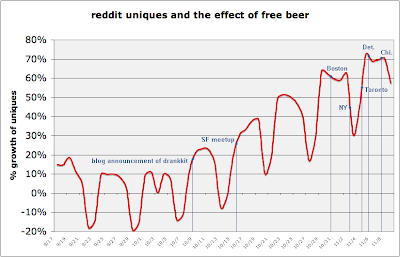
redditAll: alien artist blog: website needs traffic? an empirical study of

We wanted to meet some of our users, but just the 4 of us wouldn’t be enough of an incentive, so an open bar was necessary — Wired even offered to pick up the tab.

I don’t even remember who suggested it at the marketing meeting, but when they turned to me and asked if a free beer tour sounded like a good idea, my response (“Yes!”) came quickly and emphatically. And thus drankkit was born.

“Ah, beer. The cause of and the solution to all of life’s problems”
Posted in Computing | Tagged , , | Leave a comment

Thumbnail Page

Browse the pics on my blog by thumbnail.

e.g.

Or don’t, it’s up to you really. Don’t see why you would actually.

In case you do, sorry about the design, it was more proof-of-concept than zengarden.

Posted in Misc | Tagged | Leave a comment

Spluch: The Wooden Car with a Split Personality

A Ukrainian man gave up his job, sold his two other vehicles and spent one and a half years in his garage to create his dream vehicle. His literally half-modern, half-retro car has a wooden body made of thousands of oak parts.

Posted in Misc | Tagged | Leave a comment