Stumbleupon Review of : http://www.youtube.com/watch?v=k0YCnN7yIiE
[youtube]http://www.youtube.com/watch?v=k0YCnN7yIiE[/youtube]
…
[youtube]http://www.youtube.com/watch?v=k0YCnN7yIiE[/youtube]
[youtube]http://www.youtube.com/watch?v=6N-9zDh–h4[/youtube]
now confirmed by his label: cstrecords.com [cstrecords.com]
spinnermusic.co.uk/2009/12/25/vic-chesnutt-dead/ [spinnermusic.co.uk/2009/12/25/vic-chesnutt-dead/]
Entrenched in the Athens, Ga. music scene, Chesnutt was a songwriter's songwriter; he first earned the admiration of R.E.M.'s Michael Stipe in the late '80s and since then was praised by countless other notable songwriters and musicians, many of which eventually collaborated with him. His most recent band included members of Fugazi, Godspeed! You Black Emperor and Silver Mt. Zion Orchestra, but over the years he collaborated with members of Widespread Panic, Cracker, Lambchop, Throwing Muses, M. Ward, Cowboy Junkies and many more.
Chesnutt's national profile was elevated in 1996 when his songs were covered by an impressive list of contributors — including Madonna, R.E.M., Smashing Pumpkins and Garbage — for a Sweet Relief compilation album that benefited musicians without health insurance. Ironically and tragically, Chesnutt had health insurance and wasn't personally eligible for financial help from Sweet Relief, despite struggling to cover his significant health care costs. A car accident at the age of 18 left Chesnutt in a wheelchair, with a lifetime of complications.
He told Spinner earlier this year that "right now, I am in huge trouble in that the hospital is suing me for $35,000 for payment, which is terrifying — and the rub is that I have health insurance." His heath care debt reportedly totaled more than $50,000 and his struggles with suicide and substance abuse have been well documented.
Chesnutt leaves us with a catalog of 13 studio albums, including this year's critically acclaimed 'At the Cut,' which he was recently out on the road supporting. In a live review of one of those shows, the New York Times noted that Chesnutt's songs were contemplations on "not just mortality but also the broader inevitability of collapse and decay."
In an interview with Spinner this past September, Chesnutt admitted that, as an artist, he was difficult to pigeonhole into one specific genre. "I was labeled as alt-country for years but I never saw that at all," he said. "I like it when you're confused by an artist for a minute. I like it when everything popping out of your iPod from a band is not the same crap over and over. That makes me happy."
Vic Chesnutt — both the man and his music — made many people happy. We will remember him for that, and for his songs, which will continue to give us moments of catharsis and release.
[youtube]http://www.youtube.com/watch?v=yUvsSPEFyos[/youtube]
When we are dividing up who has the right to emit the few remaining warming gases that the atmosphere can absorb, we need to realise that we are badly overdrawn. We have used up our share of warming gases, and then some. Yet the US and EU have dismissed the idea of climate debt out of hand. How can we get a lasting deal that every country agrees to if we ignore this basic principle of justice? Why should the poorest restrain themselves when the rich refuse to?
A deal based on these real ideas would actually cool the atmosphere. The alternatives championed at Copenhagen by the rich world — carbon offsetting, carbon trading, carbon capture — won't. They are a global placebo. The critics who say the real solutions are "unrealistic" don't seem to realise that their alternative is more implausible still: civilisation continuing merrily on a planet whose natural processes are rapidly breaking down.
Throughout the negotiations here, the world's low-lying island states have clung to the real ideas as a life raft, because they are the only way to save their countries from a swelling sea. It has been extraordinary to watch their representatives — quiet, sombre people with sad eyes — as they were forced to plead for their own existence. They tried persuasion and hard science and lyrical hymns of love for their lands, and all were ignored.
These discarded ideas — and dozens more like them — show once again that man-made global warming can be stopped. The intellectual blueprints exist just as surely as the technological blueprints. There would be sacrifices, yes — but they are considerably less than the sacrifices made by our grandparents in their greatest fight.
We will have to pay higher taxes and fly less to make the leap to a renewably powered world — but we will still be able to live an abundant life where we are warm and free and well fed. The only real losers will be the fossil fuel corporations and the petro-dictatorships.
But our politicians have not chosen this sane path. No: they have chosen inertia and low taxes and oil money today over survival tomorrow. The true face of our current system — and of Copenhagen — can be seen in the life-saving ideas it has so casually tossed into the bin.

1
Living is no laughing matter :
you must live with great seriousness
like a squirrel, for example –
I mean without looking for something beyond and above living,
I mean living must be your whole occupation.
Living is no laughing matter:
you must take it seriously,
so much so and to such a degree
that, for example, your hands tied behind your back,
your back to the wall,
or else in a laboratory,
in your white coat and safety glasses,
you can die for people –
even for people whose faces you have never seen,
even though you know living
is the most real, the most beautiful thing.
I mean, you must take living so seriously
that even at seventy, for example, you'll plant olive trees –
and not for your children, either
but because although you fear death you don't believe it,
because living, I mean, weighs heavier.
1947
2
Let's say we are seriously ill, need surgery –
which is to say we might not get up
from the white table.
Even though it's impossible not to feel sad
about going a little too soon,
we'll still laugh at the jokes being told,
we'll look out the window to see if it's raining,
or still wait anxiously
for the latest newscast…
Let's say we are at the front –
for something worth fighting for, say.
There, in the first offensive, on that very day,
We might fall on our face, dead.
We'll know this with a curious anger,
but we'll still worry ourselves to death
about the outcome of the war, which could last years.
Let's say we're in prison
and close to fifty,
and we have eighteen more years, say,
before the iron doors will open.
We'll still live with the outside,
with its people and animals, struggle and wind –
I mean with the outside beyond the walls.
I mean, however and wherever we are,
we must live as if we will never die…
1948
3
This earth will grow cold, a star among stars
and one of the smallest,
a gilded mote on blue velvet –
I mean this, our great earth.
This earth will grow cold one day.
not like a block of ice
or a dead cloud even
but like an empty walnut it will roll along
in pitch-black space.
You must grieve for this right now
– you have to feel this sorrow now –
for the world must be loved this much
if you're going to say "I lived"…
February 1948

Grammar is an elitist consipracAY!
What would Jesus punctuate?
[youtube]http://www.youtube.com/watch?v=EgosV3NEJ4w[/youtube]
I wandered through each chartered street,
Near where the chartered Thames does flow,
A mark in every face I meet,
Marks of weakness, marks of woe.
In every cry of every man,
In every infant's cry of fear,
In every voice, in every ban,
The mind-forged manacles I hear:
How the chimney-sweeper's cry
Every blackening church appals,
And the hapless soldier's sigh
Runs in blood down palace-walls.
But most, through midnight streets I hear
How the youthful harlot's curse
Blasts the new-born infant's tear,
And blights with plagues the marriage-hearse.
If, however, the selfish individuals are ostracized, and rejected as mates, because of their deviant and unusual behavior, then their evolutionary advantage becomes an evolutionary liability. Cooperation in all of its very many forms then becomes evolutionarily stable. Sociability, social conventions, ritualistic behavior, expressions of the emotions, and other forms of communication between individuals, all essential ingredients for full cooperativity, can all be similarly evolutionarily stabilized by koinophilia.
Thus, whether it is a matter of joining the hunting pack, respecting the rules governing contests over territories, or gannets adhering to a convention which permits breeding on only one of two adjacent cliffs, koinophilia vigorously defends all of these practices against extinction at the hands of selfish, antisocial or nonconformist mutants*.
* or, as they are known in human society: Economists.
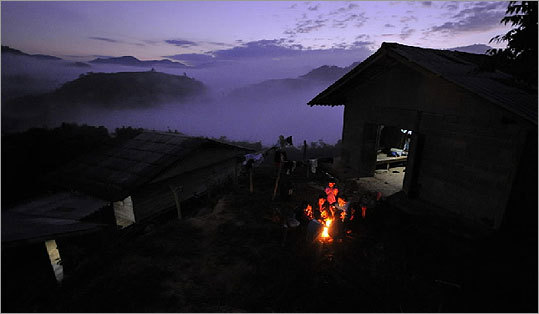
What Zomia presents, Scott argues in his book "The Art of Not Being Governed," is nothing less than a refutation of the traditional narrative of steady civilizational progress, in which human life has improved as societies have grown larger and more complex. Instead, for many people through history, Scott argues, civilized life has been a burden and a menace.
[youtube]http://www.youtube.com/watch?v=ZzDXU_AcsW8[/youtube]

